Our Treatment Approach
We had had enough of the dusty everyday life of physical therapy and cookie-cutter treatments. Our concept is based on four building blocks.

science
For us, progress isn't just a buzzword
New findings don’t belong on a shelf—they belong in practice as soon as possible. That’s exactly what we strive for at REHAFABRIK: We want to offer patients the best possible therapy by challenging traditions and consistently justifying our decisions. “We’ve always done it this way”? That’s not how we operate.
For us, modern physical therapy means combining current research with clinical experience and what truly matters to patients—their goals, their daily lives, and their expectations. This interplay is the very essence of evidence-based practice: the best available knowledge, professional expertise, and individual values must align.
To ensure new insights are implemented quickly, we work as a team that is constantly learning: We exchange ideas daily, discuss cases, review our standards, and refine them—not “from above,” but from within the team. This creates an environment where ideas are not only permitted but actively encouraged: new tests, new therapeutic approaches, better processes, smart technology.
The key point is: progress isn’t just a buzzword for us. We make it measurable—through structured rehab concepts, clear criteria, and objective data that support treatment decisions. Because effective rehab doesn’t happen by chance—it’s based on clear structures and well-founded concepts.
This is the environment we want to create: a place where physical therapy evolves every day—for patients, for the team, and for the quality of our work. And that is exactly why development doesn’t happen at some point in the future for us. Instead: every day.
communication
Why everything starts with teamwork at our company
We view physical therapy as a team effort. Not as a lone warrior in the treatment room, and not as “my patient, your patient”—but as a shared responsibility. We share patients. We work toward common goals. And we share responsibility.
This means: We communicate with one another. Clearly, directly, and as equals. We know where our colleagues excel. We know when we need a second perspective. And we know what it takes to design truly effective rehabilitation. Because growth doesn’t happen in isolation, but through collaboration.
For us, communication doesn’t end in the therapy room. Whether it’s the back office, front desk, or physical therapy—we speak the same language. Every role is part of the rehabilitation process. Every piece of information counts. Every handoff is important. This is how we ensure that no matter who is providing treatment, we know what we’re doing, what we need, and what our goal is. And patients always know: I’m in good hands here.
Openness is a central part of our culture. Addressing issues clearly. Giving feedback. Asking questions. Taking responsibility. Mistakes can also be acknowledged—because that’s the only way we can learn from them. For us, an open culture of accountability doesn’t mean weakness, but growth.
That’s why communication is a true hallmark of quality for us. And one of the reasons why REHAFABRIK gets better every day.


individuality
Effective therapy begins with a genuine relationship
Every person who comes to us is different. Different goals, different expectations, different circumstances. That’s exactly why we don’t believe in one-size-fits-all solutions. We believe in individuality.
We want to know who’s standing in front of us. Not just what the diagnosis says—but the story behind it. What motivates you? What do you respect? What do you want to be able to do again? For us, good therapy begins with a genuine relationship. With listening. With understanding. With trust.
Because only when we truly understand can we develop a therapy plan that fits. A plan that is realistic. That challenges, but doesn’t overwhelm. One that meets you where you are right now—and takes you where you want to go. For us, one thing is clear: No one knows their own body better than the patient themselves. This knowledge is not an “add-on,” but a central component of our work.
But for us, individuality doesn’t end with our patients. We also see strengths, potential, and diverse profiles within our team. One person excels in return-to-sport, another in complex pain management, and yet another in communication or exercise programming. We develop these strengths in a targeted manner—just as we do with our patients.
When we know who we’re dealing with—whether in therapy or within the team—the perfect match emerges. Then we know exactly where to start. And that’s precisely where progress begins.
activity
Exercise as a Path to Self-Efficacy
We meet people exactly where they are. Sometimes rehabilitation begins on the treatment table, with pain, uncertainty, or limited physical capacity. And that’s perfectly fine. Passive interventions can be an important part of the process. They build confidence, reduce discomfort, and prepare the patient for the next step.
But our shared goal goes further: step by step toward activity and self-efficacy.
Because long-term progress happens when patients learn to understand their bodies again, to challenge them, and to trust them. Support turns into self-initiative. Guidance turns into action. Uncertainty turns into stability. We consciously guide this transition—tailored to each individual, structured, and adapted to their specific fitness level.
In doing so, we don’t focus on short-term effects, but on sustainable results. It’s not just about reducing symptoms, but about building resilience. Not just about the next pain-free day, but about long-term performance in daily life, at work, or in sports.
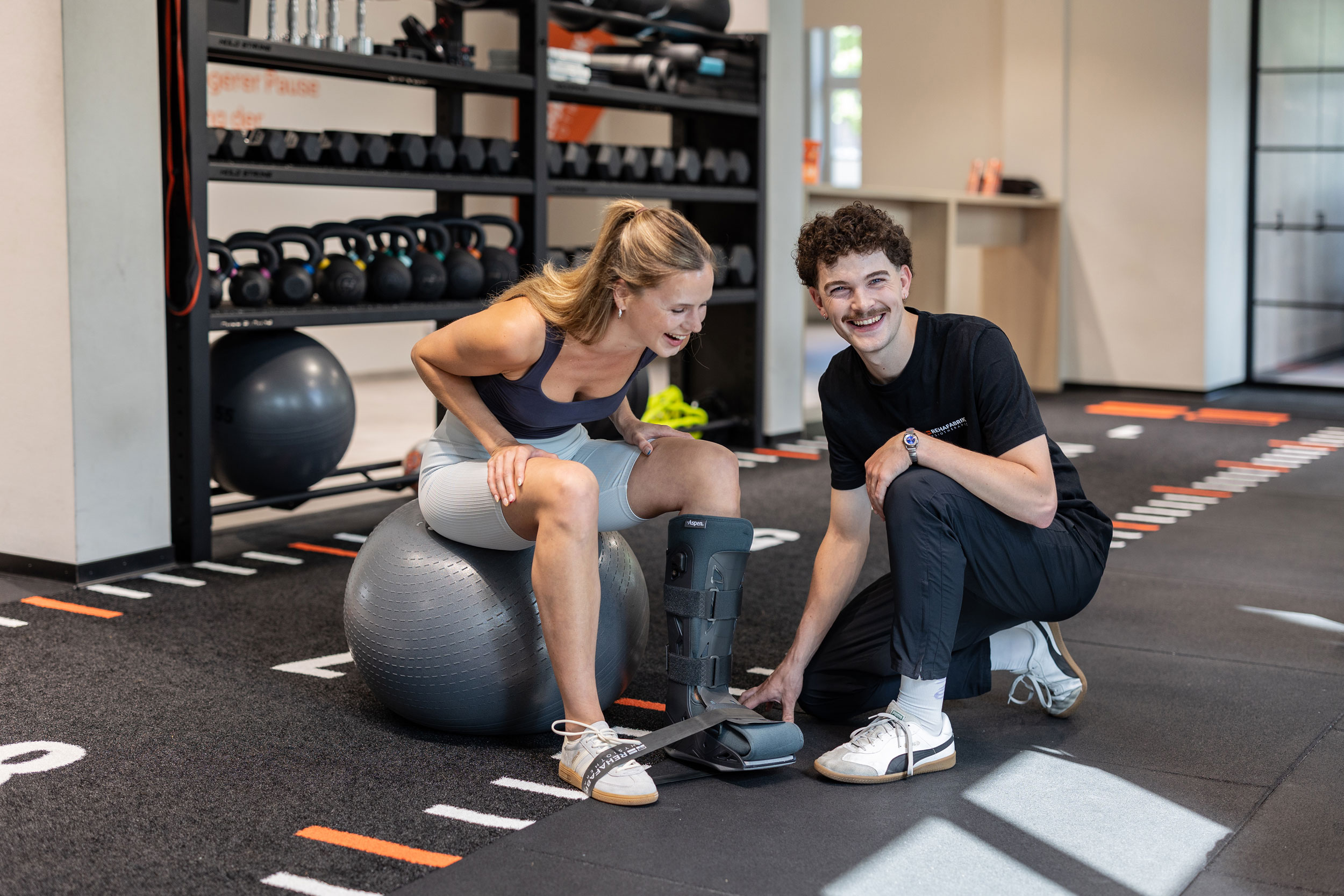
To optimize this journey, our locations offer spacious active therapy areas with a wide range of training options. Here, there is room for progression, for targeted load management, and for individualized approaches. Therapists can put their ideas into practice, and patients can reach their full potential.
That is why activity is a crucial building block for us. It makes therapy tangible, measurable, and sustainable.
This is how we create a framework in which both you, as a physical therapist, and your patients can reach your full potential—step by step, with structure and a clear goal in mind.